
Differences and Similarities Between Chinese and English Poetry
Poetry Review #1

Chinese poetry can be traced back to around 2000 BC, during the early dynasties of China, such as the Western Zhou Dynasty and the Warring States period. On the other hand, English poetry began to develop around 600 AD (Roland, p420-428). Despite the significant differences in their origins and languages, Chinese and English poetry share several similarities.
English poetry is composed of various elements, including lines, content, themes, forms, meter, rhyming patterns, and often a title. With such diverse components, it is nearly impossible to find two poems that are exactly the same. Every conceivable theme has been explored in English poetry, ranging from love, life, and nature to death and growth.
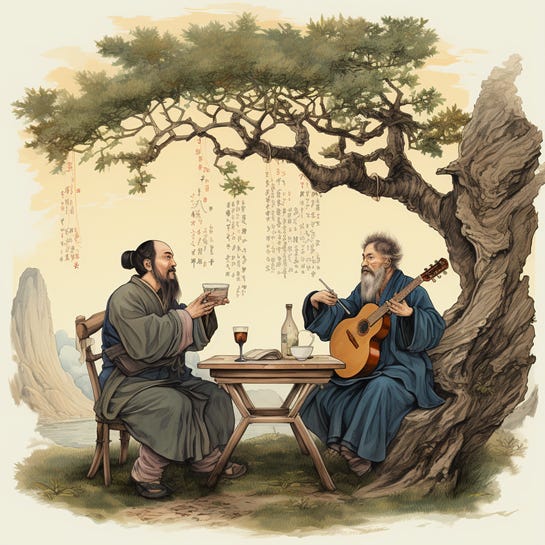
Chinese poetry bears some resemblance to English poetry in terms of themes and forms. The forms of Chinese poetry are relatively limited, mainly comprising five-character lines, seven-character lines, and poems with four or eight lines (Wang, Vol. 17). The rhyming pattern may differ in each poem, but commonly follows ABAB or ABCB. Despite this, Chinese poetry often reflects similar themes, such as bidding farewell to someone, describing a scenic view, or using symbolism to express personal emotions. For example, in the fifth poem of Gong Zizhen’s “Jihai Year Sundry Poems,” the poet writes:
浩荡离愁白日斜,吟鞭东指即天涯。落红不是无情物,化作春泥更护花。
Boundless my grief at leaving as the white sun sinks west,
And the poet points east with his whip to the far horizon;
Red blossoms, though fallen, have some feeling still,
Turned into mud in spring they want to protect the tree.
(Translated by Yang Xianyi)
In this poem, the “fallen red blossoms” symbolize the poet himself. The poet conveys the sentiment that even though he has left the government, he will continue to care about the nation.
A fundamental difference between Chinese and English poetry lies in their written language. While English poems may occasionally employ Old English terms like “thee” or “thy,” Chinese has evolved into two distinct types: ancient Chinese and modern Chinese. Ancient Chinese is highly concise and has a completely different grammar and word usage. An expert in modern Chinese may not even fully comprehend a text written in ancient Chinese.
Despite the differences, there are also numerous unexpected similarities between the two poetic traditions. Many rhetorical devices found in English poetry, including alliteration, onomatopoeia, simile, metaphor, symbolism, and hyperbole, also appear in Chinese poetry. These rhetorical devices create similar effects in both traditions, making it possible to enjoy and appreciate both styles of poetry, despite their apparent differences.
As previously mentioned, English poetry encompasses a myriad of themes, with countless poems exploring each theme in depth. For instance, in “Jabberwocky,” the author describes a son slaying a monster, the Jabberwock, and returning triumphantly. However, the actual moral of the poem is that evil cannot be fully eradicated, nor can goodness.
In conclusion, Chinese and English poetry exhibit numerous differences, but they also share unexpected similarities. While they have similar elements and rhetorical devices, Chinese poetry maintains a distinctive and highly symmetrical form, often employing symbolism to express the author’s emotions. Nevertheless, these poetic traditions share common ground despite their unique characteristics.
Works Cited:
Roland, Greene, et.:The Princeton Encyclopedia of Poetry and Poetics. 4th Rev ed., Princeton University Press, 2012. p420-428.
Wang Li: Full Collection of Wang Li. Vol. 17, Zhonghua Book, 2015.